AI Automation for Small Businesses: A Complete Guide to Scaling Faster in 2026
In today’s competitive market, small businesses face a constant challenge—doing more with fewer resources. Limited budgets, small teams, and increasing customer expectations make it difficult to scale efficiently.
This is where AI automation is becoming a game changer.
In 2026, artificial intelligence is no longer reserved for large corporations. Small businesses are now leveraging AI to automate repetitive tasks, improve efficiency, and compete with bigger players—without increasing costs.
🚀 What Is AI Automation?
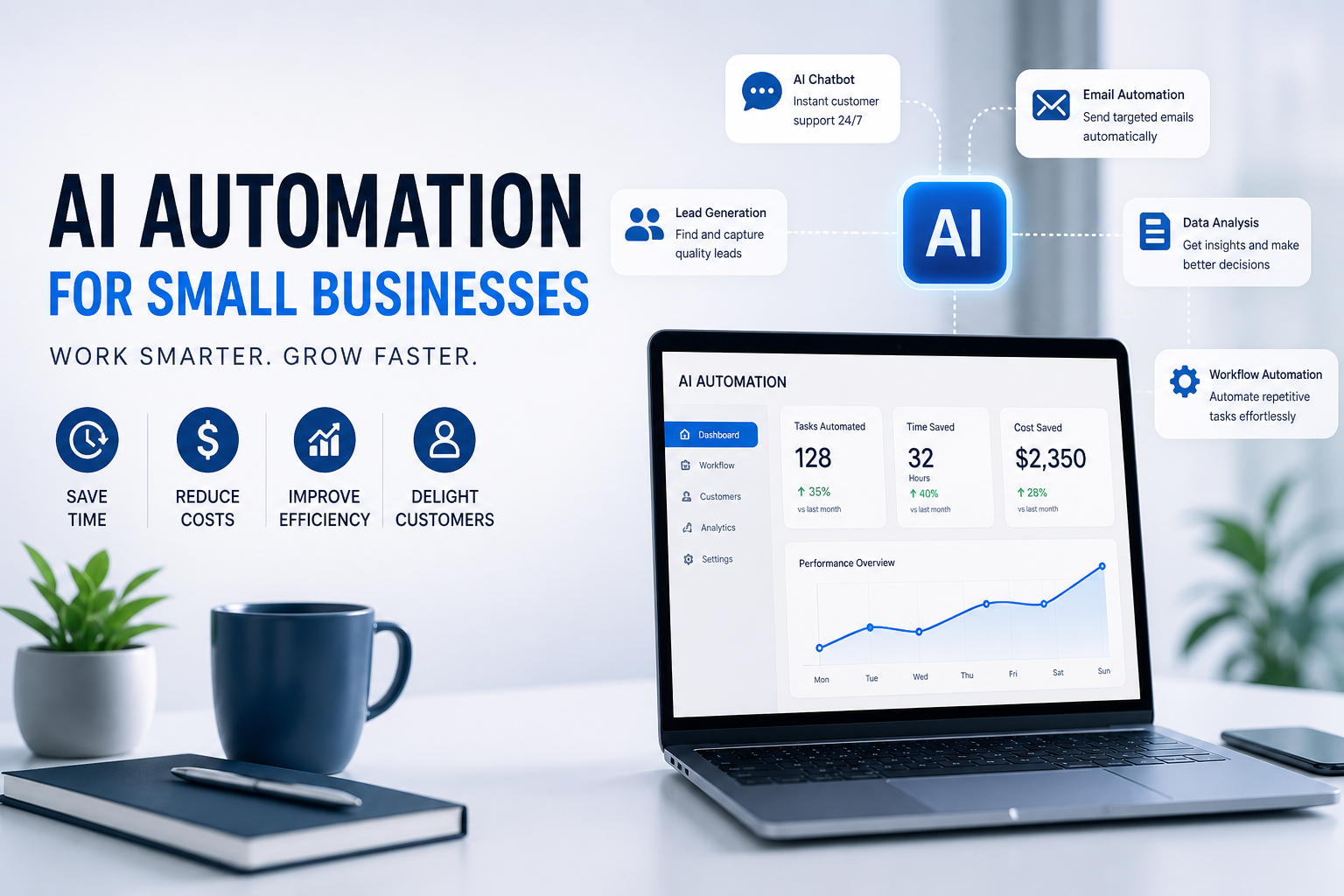
AI automation refers to using artificial intelligence to perform tasks that typically require human effort. These tasks can include:
Responding to customer queries Sending emails Managing data Generating content Analyzing customer behavior
Instead of doing everything manually, businesses can automate workflows and save both time and money.
⚡ Why Small Businesses Need AI Automation
Small businesses often struggle with:
❌ Limited Workforce
Hiring more employees increases operational costs.
❌ Time Constraints
Manual tasks consume valuable time that could be spent on growth.
❌ Human Errors
Repetitive work often leads to mistakes.
❌ Slow Growth
Without automation, scaling becomes difficult.
🤖 How AI Automation Solves These Problems
AI automation allows businesses to operate smarter, not harder.
✅ Increased Efficiency
Tasks that take hours can now be completed in seconds.
✅ Reduced Costs
Less reliance on large teams means lower expenses.
✅ Faster Decision-Making
AI tools analyze data quickly and provide actionable insights.
✅ Scalability
Businesses can handle more customers without increasing staff.
🔥 Key Areas Where AI Automation Helps
- Customer Support
AI chatbots can handle most customer queries instantly, reducing the need for support agents.
- Marketing Automation
AI can:
Send personalized emails Run ad campaigns Analyze customer behavior
This leads to higher engagement and better conversions.
- Lead Generation
AI tools can identify potential customers and collect leads automatically, helping businesses grow faster.
- Data Analysis
Instead of manually analyzing spreadsheets, AI can:
Identify trends Predict customer behavior Suggest improvements 5. Content Creation
AI tools can generate:
Blog posts Social media content Product descriptions
This saves time and ensures consistent content production.
🛠️ How to Get Started with AI Automation
Starting with AI might seem overwhelming, but it doesn’t have to be.
Step 1: Identify Repetitive Tasks
Look for tasks that consume time and don’t require deep thinking.
Step 2: Choose the Right Tools
Select AI tools that match your business needs (chatbots, email automation, analytics, etc.).
Step 3: Start Small
Begin with one process, such as customer support or email marketing.
Step 4: Scale Gradually
Once you see results, expand automation to other areas.
🛒 Real-World Example
Imagine a small online store:
Before AI: Manually replying to customer messages Sending emails individually Tracking orders manually After AI Automation: Chatbot handles customer queries Automated emails for promotions AI tracks and updates orders
👉 Result:
50% less workload Faster response time Increased sales 📈 Benefits of AI Automation for Small Businesses Save time and focus on growth Reduce operational costs Improve customer experience Increase productivity Scale without hiring more employees ⚠️ Challenges to Consider
While AI automation offers many benefits, there are some challenges:
❗ Initial Learning Curve
Understanding and setting up AI tools takes time.
❗ Tool Selection
Choosing the wrong tools can reduce efficiency.
❗ Over-Automation
Too much automation can make interactions feel impersonal.
🔮 The Future of Small Business with AI
The future belongs to businesses that adopt automation early. AI will continue to evolve, making tools more accessible, affordable, and powerful.
Small businesses that leverage AI today will be better positioned to scale, compete, and succeed in the long run.
✅ Conclusion
AI automation is no longer a luxury—it’s a necessity for small businesses looking to grow in 2026 and beyond.
By automating repetitive tasks, improving efficiency, and reducing costs, AI allows businesses to focus on what truly matters—innovation, strategy, and customer relationships.